
The Matter with Things
And the Patron Saint of the Anomalous: Simone Weil

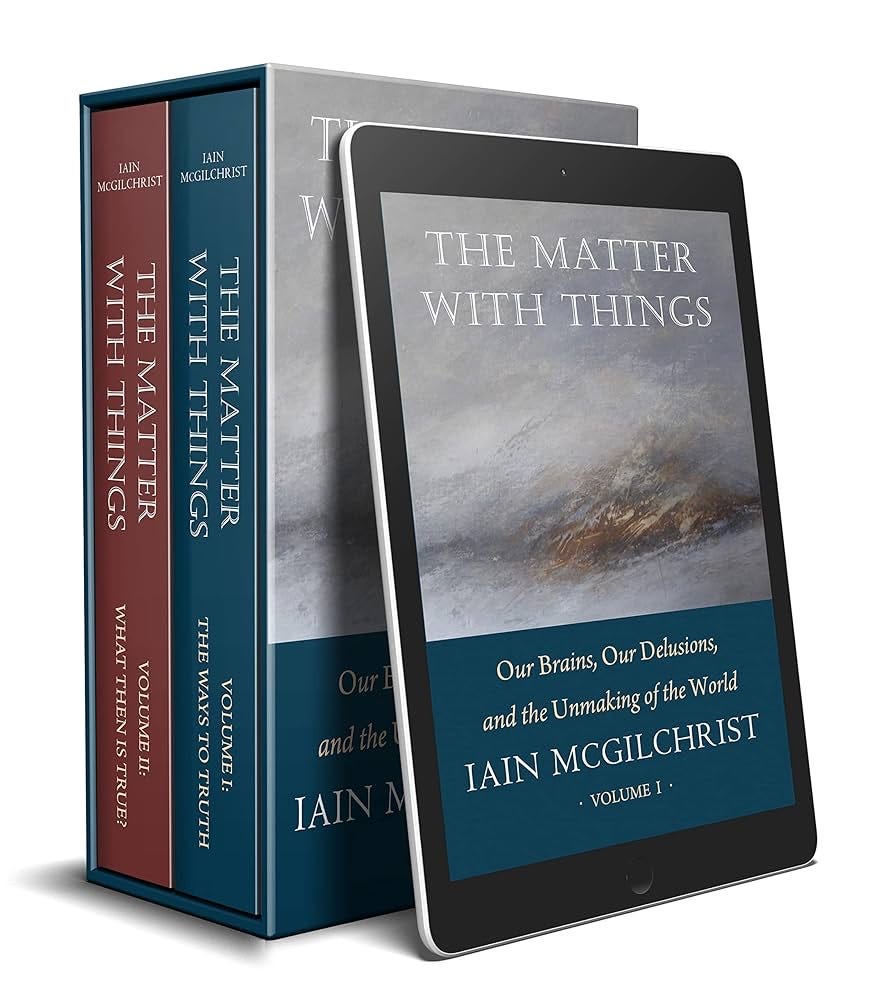
The Matter with Things by Iain McGilchrist argues about the dangers of perceiving the world in a distorted manner and does so on a monumental scale that is not only philosophical in ambition but occasionally overwhelming in its intellectual range. It is at once rigorous neuroscience and civilisational diagnosis, seamlessly bleeding into metaphysical territory, while formally presenting itself as a study of the brain.
The book extends and deepens arguments first explored in The Master and His Emissary, but here the stakes are higher. McGilchrist is no longer merely demonstrating that the brain’s hemispheres attend differently to reality. He is attempting to show that Western modernity has become trapped within a pathological style of attention that is narrow, reductive, mechanistic and incapable of apprehending wholeness.
His most important claim is that attention is not passive observation but an active mode of participation in reality: “Attention changes the world,” he writes. “How you attend to it changes what it is you find there.” This is the book’s governing metaphysical principle. McGilchrist is not alone in making attention a philosophical principle of virtue and intellectual vigour. Simone Weil, writing in the shadows of the Second World War, argued that truly paying attention to another person — emptying oneself of preconception and agenda — was not merely a cognitive act but the highest form of love. For Weil, attention was the soul’s orientation toward reality; its degradation was not ignorance but a kind of spiritual violence. McGilchrist arrives at a structurally similar position from neuroscience rather than mysticism, which makes the convergence all the more arresting.
What makes McGilchrist’s argument compelling is his refusal of simplistic binaries. He is not peddling fashionable anti-scientific mysticism. One of the book’s genuine strengths is its fierce defence of science against both crude materialism and postmodern relativism. He rejects what he calls “Reality Out There (ROT)” — naïve realism on one side — and “Made Up Miraculously By Ourselves (MUMBO)” — naïve idealism on the other.
This balancing act is crucial. McGilchrist insists that reality exists independently of us, yet can only be encountered relationally: “The relationship comes before the relata,” he writes, in one of the book’s most philosophically consequential lines. “What we mean by the word ‘and’ is not just additive, but creative.” That sentence contains, in miniature, the spirit of the entire work. McGilchrist is arguing against the atomistic assumptions of modern thought — the idea that isolated objects, isolated selves, isolated facts, or isolated disciplines can adequately explain reality. For him, relation is ontologically primary. The world is not composed fundamentally of things, but of processes, flows, reciprocities, and encounters. Weil would have recognised this immediately. Her conception of affliction — the condition of those rendered invisible by suffering — depended precisely on the idea that the wrong kind of attention annihilates the other, reducing a person to an obstacle or abstraction. What restores them is not pity but the radical receptivity she called attente: a waiting, an openness, a willingness to be changed by what one sees. McGilchrist’s relational ontology gives this Weilian intuition a neurological grounding it never had in her own lifetime.
This becomes especially vivid in passages where McGilchrist overturns conventional assumptions about order and simplicity. In a striking inversion of modern reductionism, he argues that “complexity is the norm, and simplicity represents a special case of complexity.” Likewise, “order is not a special case of randomness, but randomness merely the limit case of order.” These are not merely provocative formulations. They constitute a sustained philosophical rebellion against the mechanistic worldview inherited from the Enlightenment and intensified by late capitalism and technocracy. McGilchrist’s recurring charge is that the modern West mistakes abstraction for reality, making the map more authoritative than the terrain.
At times, the prose rises to something approaching philosophical poetry. For instance, one of the book’s recurring metaphors compares reality to music — jazz, improvisation, live performance. Reality, he suggests, is neither wholly predetermined nor chaotic, but emerges through responsive participation: “It won’t exist until it is being performed, no-one can know exactly what it will be like. But it will not be random: will emerge from the players’ continuous interaction.” This is quintessential McGilchrist — deeply anti-mechanistic without collapsing into irrationalism. The world is lawful but alive; structured but creative. One hears in this an echo of Weil’s insistence that beauty — whether in mathematics, in art, or in another human face — demands a particular quality of receptive stillness. To impose one’s own categories upon it is to destroy it. To truly attend is to allow it to disclose itself on its own terms.
The book’s philosophical architecture rests on the distinction between the brain’s two hemispheres. The left tends toward narrow, utilitarian, manipulative attention; the right sustains broad, relational, contextual awareness. He summarises the distinction elegantly when discussing animals surviving in the wild: the left hemisphere is deployed “for paying narrow-beam, sharply focussed attention to the world, for the purpose of manipulation,” while the right attends openly and vigilantly “in order to understand and relate to the bigger picture.” Importantly, McGilchrist resists reducing people to “left-brained” or “right-brained” caricatures. Both hemispheres participate in almost everything we do. The difference lies not in what they do, but in how. “It is not the what, but the how, that matters.”
Translated into Weilian terms, the left hemisphere attends in order to use; the right attends in order to receive. The pathology McGilchrist diagnoses in Western modernity is therefore not merely cognitive but ethical — a civilisation that has forgotten how to receive the world, increasingly capable only of processing, extracting, and manipulating it.
This distinction gives the book extraordinary explanatory reach. McGilchrist connects neuroscience to philosophy, aesthetics, politics, religion, ecology, and architecture with unusual fluency, arguing that modern society increasingly privileges the left hemisphere’s mode: fragmentation, categorisation, utility, measurement, and control.
One of the book’s most penetrating insights concerns reductionism. McGilchrist observes that reductionist thinking always mistakes partial description for total explanation. His example of the mountain is superb: to Vikings, a landmark; to the Picts, sacred shelter; to geologists, a basalt formation; to physicists, solidifying empty space. “Which of these is the ‘real’ mountain?” he asks. None is wholly false; each is radically incomplete. The critique extends far beyond science. McGilchrist is ultimately interrogating a civilisation that experiences reality increasingly through systems, metrics, bureaucracies, algorithms, and abstractions. The danger is not science but scientism — the belief that what can be measured exhausts what is real. Weil made a comparable observation when she noted that the afflicted become invisible not because others are cruel, but because the dominant frameworks of attention simply have no category for them. Suffering that cannot be quantified or instrumentalised disappears from view.

One of the book’s finest formulations comes near its opening: “The world we know cannot be wholly mind-independent, and it cannot be wholly mind-dependent.” This middle path — neither crude materialism nor solipsistic relativism — is where the work does its deepest thinking. It is also, one might note, the epistemological space Weil occupied: reality is given, not constructed, but it can only be received by a consciousness willing to subordinate itself to what is actually there.
Its scale is both astonishing and exhausting. At over 1,500 pages, the argument occasionally becomes too accumulative. McGilchrist’s associative method means ideas spiral through philosophy, neuroscience, quantum theory, literature, theology, and phenomenology in rapid succession. Readers accustomed to analytic precision may find portions maddeningly diffuse. There is also the question of evidentiary overreach: McGilchrist frequently moves from neurological observation to civilisational diagnosis with enormous confidence. While often brilliant, these leaps can feel more suggestive than demonstrable. One may reasonably ask whether Western modernity’s crises can be mapped so directly onto hemispheric asymmetry.
The book’s deepest achievement, however, is in compelling readers to notice how they notice. McGilchrist insists that attention is moral: “The choice we make of how we dispose our consciousness is the ultimate creative act. It is, therefore, a moral act.” Weil could not have put it more precisely. For her, the refusal to attend — to truly see another person, another creature, another reality in its full weight and particularity — was not neutral inattention but a form of ethical abdication. Both thinkers converge on the same unsettling conclusion: how we pay attention is not a private cognitive matter but a civilisational and spiritual responsibility. In an era defined by distraction economies, algorithmic manipulation, and informational fragmentation, this convergence lands with startling force.
One cannot read this book without thinking about contemporary political life, social media, artificial intelligence, ecological collapse, and the commodification of human experience. McGilchrist rarely descends into polemic, but his target is unmistakable. A civilisation that increasingly privileges control over understanding, data over wisdom, utility over meaning is precariously tethering to the brink of collapse. What Weil called the social mechanisms that crush the inner life of persons — bureaucracy, propaganda, uprooting — McGilchrist maps onto the neurological and philosophical infrastructure that makes such mechanisms possible and self-perpetuating.
Yet the book is neither despairing nor cynical. Beneath its critique lies an almost sacramental vision of reality — grounded in participation, responsiveness, reciprocity, and wonder. Near its opening, McGilchrist describes the world as “a seamless, always self-creating, self-individuating, and simultaneously self-uniting, flow.” That sentence captures both the beauty and difficulty of the book. It asks readers to abandon the comfort of fixed certainties and inhabit a world understood dynamically, relationally, participatively. This is not far, in spirit, from what Weil meant when she described the act of true attention as a form of self-abnegation — a willingness to be, for a moment, nothing, so that what is real might fully appear.
The Matter with Things is not an easy book. It demands patience, intellectual humility, and sustained concentration — precisely the virtues McGilchrist believes modern culture is losing, and precisely the virtues Weil believed were the foundation of western civilisation through Judea-Christian emphasis of both justice and love. But for readers willing to undertake the journey, this is one of the most ambitious philosophical works of the century so far: part neuroscience, part metaphysics, part cultural criticism, part plea for the recovery of a more humane mode of attention.
It is, above all, a book that refuses to let reality become smaller than it is.
On my TBR!