
Sincerely Boring

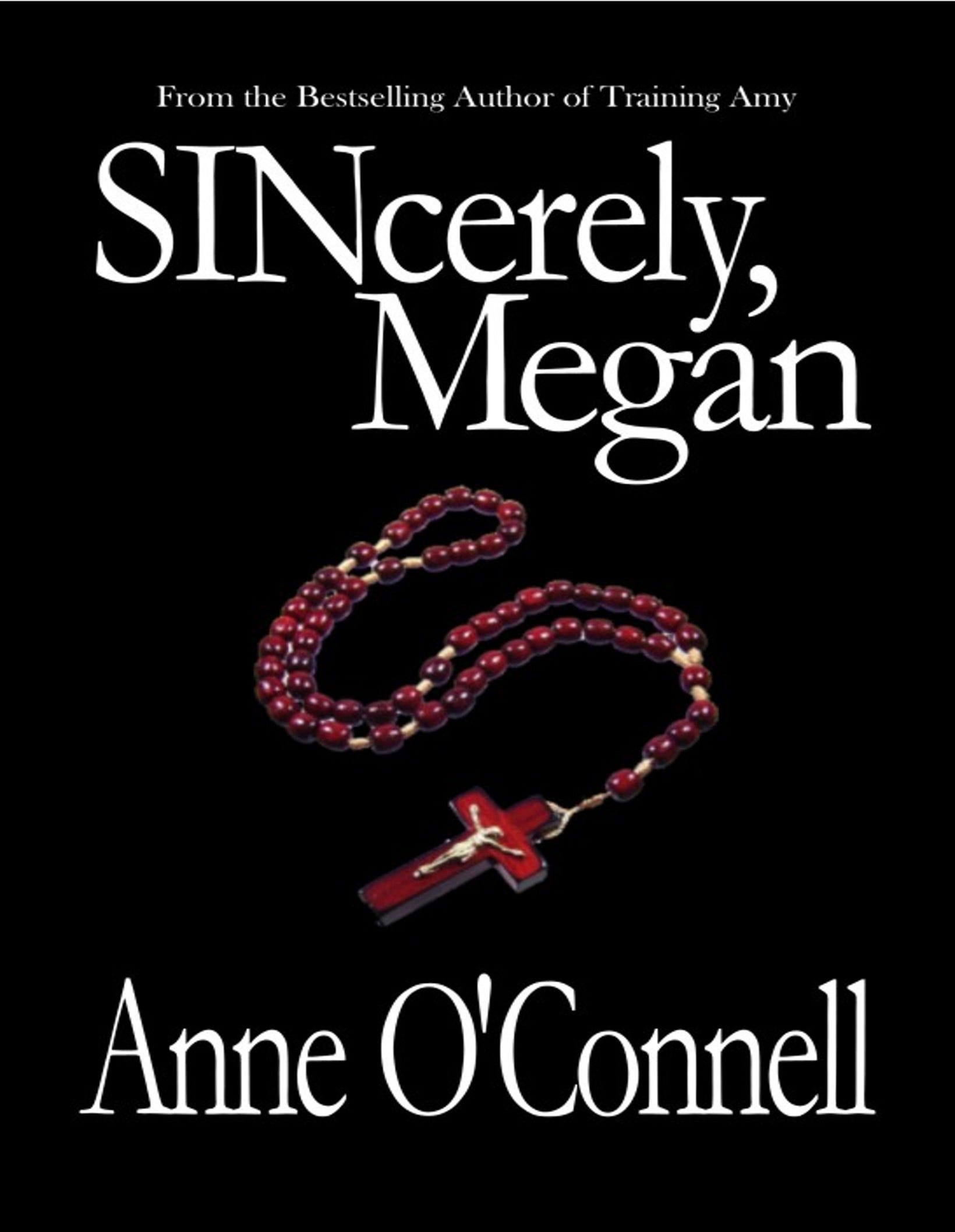
Erotic fiction has long been drawn to the precincts of prohibition, to those domains—religion, ritual, moral authority—where desire is not merely discouraged but given its most elaborate vocabulary of sin. SINcerely, Megan by Anne O’Connell situates itself precisely within this charged terrain, where the confessional becomes less a site of absolution than of exposure. Yet what is striking is not its willingness to enter such territory, but its reluctance to dwell in the tensions that make it meaningful.
The novel opens with a gesture toward seriousness: grief. Megan, recently bereaved, returns to church in the aftermath of her mother’s death. This is, in principle, an entry point into one of literature’s oldest recognitions—that mourning unsettles the body as much as the soul, that desire can emerge in spite and through loss. Grief in the novel though is not an animating force but a narrative pretext that briefly appears before being subsumed by a far more insistent current of sexual fixation.
The object of that fixation, Father Michaels, is a figure who should, in a more exacting novel, carry the full weight of contradiction. He is, after all, both confessor and transgressor, a man whose vocation rests on renunciation and whose authority derives from moral discipline. But in SINcerely, Megan, this contradiction is bypassed. The priest does not struggle; he yields, almost immediately. Thus we have no psychological tensions to explore. What might have been a drama of conscience becomes instead a choreography of eroticism.
The confessional—arguably the most psychologically charged space in Catholic ritual—is transformed into antechamber of what Megan calls “unclean thoughts,” delivered in the language of penitence that quickly slides into performance. The priest’s role, ostensibly to guide, becomes one of participation. The boundary between spiritual counsel and erotic complicity dissolves with remarkable speed, and without the friction one expects from such a collapse.
It is not that literature cannot accommodate such transgressions. On the contrary, some of its most enduring works are built upon them. But transgression, to be meaningful, requires resistance—internal, social, theological. It requires the sense that something is being risked, not merely indulged. This novel invokes sin without sustaining its gravity. What replaces it is a language of control.
As the relationship between Megan and Father Michaels deepens, it is reframed in the idiom of BDSM: dominance, submission, the ritualised exchange of power. The introduction of a “safe word,” the codification of roles, the careful staging of punishment—these elements suggest an attempt to impose structure on what would otherwise be chaos. Yet the structure feels retrospective, almost justificatory, rather than organically developed.
The difficulty is not simply that the relationship is transgressive; it is that it is asymmetrical in ways the novel declines to interrogate. Priest and parishioner, counselor and penitent—these are not neutral positions. They carry institutional weight, histories of authority and trust. When such roles are eroticised, the question is not merely whether consent is present, but whether it can be disentangled from influence.
The novel gestures toward consent—Megan is, by all appearances, willing, even eager—but willingness alone does not resolve the ethical tension. Indeed, it complicates the negotiated equilibrium of power exchange with something closer to absorption: Megan’s subjectivity narrowing as her desire to please intensifies.
And yet, the novel is not without a certain inadvertent candor. It reveals, perhaps more clearly than it intends, the mechanics of a particular fantasy of transfiguring authority into intimacy. The priest is not only desired; he is needed—first as spiritual guide, then as erotic master, and finally as romantic partner. Each role replaces the last without fully displacing it, leaving intact the aura of control that made him compelling in the first place.
Father Michaels is granted a backstory of an earlier loss that made possible his retreat into the priesthood as a form of penance. It is a familiar psychological arc: grief transmuted into repression, repression into self blame and penitentiary excess. But this, too, in this novel, is sketched rather than inhabited. His decision to abandon the church, to exchange cassock for domesticity, arrives with a confidence that feels less like resolution than narrative convenience.
The final movement of the novel—its turn toward a shared future—reveals its deepest ambivalence. Having traded on the charged symbolism of the church, it quietly exits that terrain. The scandal that should follow—the institutional repercussions, the communal shocks, the theological reckoning—remains largely hypothetical. The world beyond the lovers scarcely intrudes.
In this sense, SINcerely, Megan is a novel that invokes structures it does not fully acknowledge. Religion is present as imagery but not as system; power is enacted but not examined; grief is introduced but not sustained. What you get is a sequence of intensities, vividly rendered but curiously unmoored into any real narrative structure.
One might say that the book is less interested in the moral architecture of its setting than in its aesthetic possibilities. Fine. But that makes its confessional too staged, the altar a prop, the language of sin a kind of ornament. This is not, in itself, illegitimate—fiction has always repurposed the sacred—but it carries a cost. Without the weight of what is being repurposed, the transgression loses depth and becomes merely decorative.
And yet, to dismiss the novel outright would be to overlook what it inadvertently captures: the persistence of desire in the shadow of authority, the way structures meant to contain the body can, under pressure, become the very sites of its release. If the book does not fully understand these dynamics, it nonetheless circles them, returning again and again to the same question, unarticulated but insistent: What happens when the language of salvation becomes indistinguishable from the language of possession?
It is a question the novel raises more compellingly than it answers.
Really enjoyed this review. I think this is the reason why many people see eroticism as fluff. Which is fine if that's what you're into, and sex sells after all. What you so beautifully state is that even within something like erotica, there is so much potential to explore deeper themes, AND that would make it even more erotic I think.