
Letters to Sartre

I have long been curious about how others read, largely because my own habits resist any linear discipline. I tend to read five or more books at once, usually across different genres, which allows me to keep them distinct even as they accompany my daily life. I do not so much “finish” books in orderly succession as live with them—moving between voices, arguments, and sensibilities as mood and circumstance dictate.
This method makes me susceptible to interruption, an easily waylaid reader. A passing reference, a sudden curiosity, or the quiet insistence of a newly discovered text can easily displace what I have already begun. Consequently, some books remain with me for years—two, three, sometimes even ten—half-read yet never fully abandoned. I often rediscover them while repacking or rearranging my shelves: a bookmark suspended in time, a former self lingering in the margins. Occasionally, I return and complete one in a single, concentrated burst; at other times, the book resists me again, its cadence misaligned with my present disposition. Those I set aside into what I privately call my “retirement reads”—demanding, monumental works that seem to require a different season of life: War and Peace, Finnegans Wake, and others of that order.
What I find most satisfying, however, is when several of these long-suspended readings resolve themselves at once—when books begun months or even years apart converge toward completion within the same span of time. April proved unusually generous in this regard. I finished a windfall of six books that had been waiting on me, some for years. I shall talk about them here in the coming few weeks. Stay tuned.
Which brings me, then, to the present review, a book I begun months ago and, at last, brought to its conclusion last long weekend.
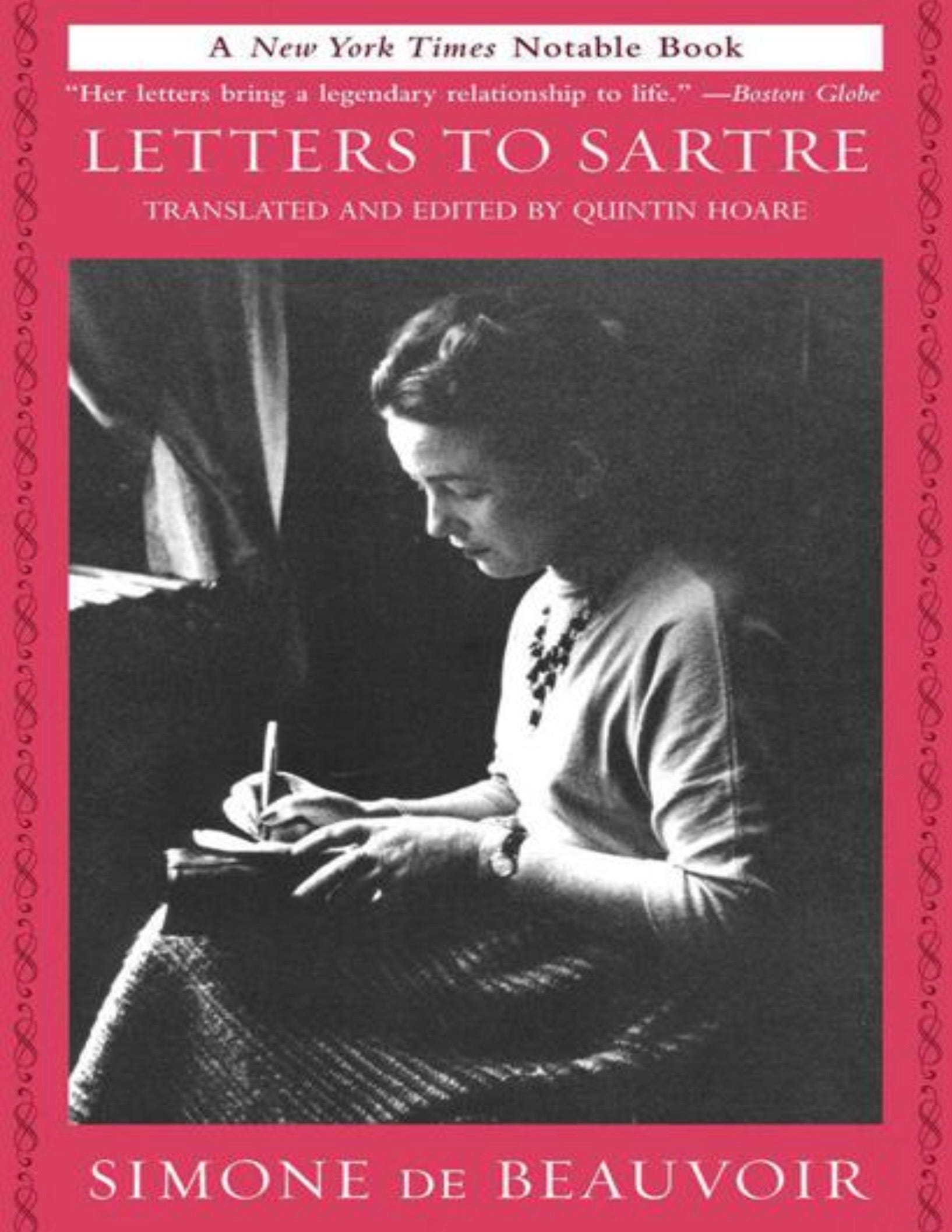
Letters to Sartre by Simone de Beauvoir is not merely a collection of private correspondence; it is an existentialist document in its own right. The letters operate simultaneously as autobiography, philosophical laboratory, emotional archive, and ethical experiment. They are, in many respects, more revealing than The Second Sex because they lack intellectual polish. Instead, they present a far more unstable, searching, and often raw—at times even contradictory—engagement with the burden of being.
From the earliest letters of the 1930s, Beauvoir establishes a tone of relentless emotional transparency. Her language is intimate, repetitive, and distinctly performative:
“My love, I never felt our love more strongly… I was brimming over with love for you and happiness” (p. 12).
Love, for Beauvoir, must be continually narrated in order to sustain its existence. The letters function as the maintenance of presence across absence. Yet even in these early declarations, the central paradox of their relationship is evident: the intensity of attachment coexists with a commitment to radical freedom. Their bond is not exclusive in any conventional sense, and this tension defines the entire corpus.
What distinguishes these letters from conventional love correspondence is the couple’s refusal to conceal other relationships. Beauvoir documents, often in striking detail, her simultaneous emotional and sexual involvements:
“Something extremely agreeable has happened to me… I slept with Little Bost three days ago… it’s something precious to me… but also light and easy and properly in its place in my life” (p. 287).
Here one sees her conception of “contingent loves”—relationships that exist alongside the “necessary” bond with Sartre. Contemporary language might call them relationships with a “shelf life.” She does not frame this as betrayal but as an extension of existential freedom. Yet the tone is revealing. The insistence that such experiences are “light and easy and properly in [their] place” suggests an ongoing effort to discipline emotional life into philosophical coherence. The letters expose the strain inherent in this project.
Another striking feature is Beauvoir’s attention to the mundane. She writes extensively about travel, food, weather, fatigue, and minor bodily discomforts:
“I did 35 km… without feeling tired… I had some milk and eggs… I arrived here half an hour ago and am now writing to you before going off to bed” (p. 233).
At first glance, such details appear trivial. Yet they are philosophically significant. They embody the existentialist insistence that meaning is not abstract but lived, contingent, and embodied. The letters are saturated with what the introduction calls “the everyday dust of life” (p. xxi)—the material from which Beauvoir constructs both selfhood and relationship.
During the war years, when Sartre is mobilised and later imprisoned, the correspondence acquires a new urgency. Separation transforms the letters into lifelines:
“I fell asleep and awoke in anguish at your leaving… I love you quite passionately—and with a touch of tragedy” (p. 341).
The recurring phrase “a touch of tragedy” signals an awareness that their relationship, for all its intellectual ambition, is not immune to ordinary human vulnerability—fear, dependency, longing, even jealousy. The war strips away earlier playfulness and reveals a deeper emotional reliance than their philosophy might comfortably admit.
A more troubling dimension emerges in the subtle asymmetries of power within their ostensibly “free” relationship. Beauvoir frequently narrates situations involving younger women—students and protégées—who become entangled in the Sartre–Beauvoir orbit. Even when not fully detailed, a tone of management and emotional orchestration is evident. Beauvoir often positions herself as mediator, strategist, and interpreter of others’ feelings. This complicates any idealised notion of mutual freedom. The letters suggest a system requiring constant negotiation—and, at times, emotional manipulation—to sustain itself.
Stylistically, the letters are remarkable for their velocity. Beauvoir writes quickly, almost breathlessly, shifting from logistical detail to philosophical reflection to erotic confession within a single page. Repetition becomes a defining device:
“I love you, I love you… I kiss you passionately… I love you quite passionately” (pp. 12, 233, 341).
This repetition is not a failure of expression but a performative act that enacts the persistence of feeling across time and distance. At the same time, it hints at an underlying anxiety—the need to continually reaffirm what might otherwise dissipate.
As the introduction observes, these letters disrupt Beauvoir’s carefully curated public image, revealing “how successful she had been in taming… enquiry… turning the old iconoclast into a benign totem” (p. xvii). This is less a matter of hypocrisy than of complexity. Beauvoir appears here as both fiercely independent and deeply attached, intellectually rigorous and emotionally impulsive, ethically ambitious and pragmatically compromised. This multiplicity is not resolved but lived in rather pretence nonchalance at times.
In this sense, Letters to Sartre can also be read as a practical test of existentialist ethics.
Freedom is pursued relentlessly, but often at emotional cost.
Authenticity is sought through radical honesty, yet complicated by self-justification.
Responsibility remains unevenly distributed across relationships.
The book is therefore not an illustration of existentialism but a stress test on it. It is demanding, and at times disconcerting, precisely because it resists moral simplification. Readers seeking romantic idealisation will instead encounter a complex system of emotional negotiation. Those in search of philosophical clarity will find ambiguity. Those inclined toward religious ethics may interpret its unbounded freedom as licentiousness. Yet it is precisely this tension that renders the collection indispensable.
The letters depict both Beauvoir and Sartre as working consciousnesses—thinking, feeling, erring, recalibrating. They document the lived difficulty of aligning a philosophy of freedom with the stubborn realities of human attachment, particularly the exclusivity that romantic love seems to demand. Perhaps the most accurate description of the work is already contained within it: “love and passion… frustration, disappointment… jealousy, fear, anger, hope, wish, dream” (p. xx). These are the elements of the human condition. Which we accumulate in greater measure shapes our character—and what the ancients might have called fate.
One conclusion remains inescapable from reading the letters: life is messy, unresolved, and intensely burdensome in its demands. The struggle to fall, to rise, and to continue remains perpetual. The greatest gift of these letters is that they provide a structure of thought through which to confront this reality. That, ultimately, may be their most enduring achievement.