
Constitutional Reckoning in the Phala Phala Matter

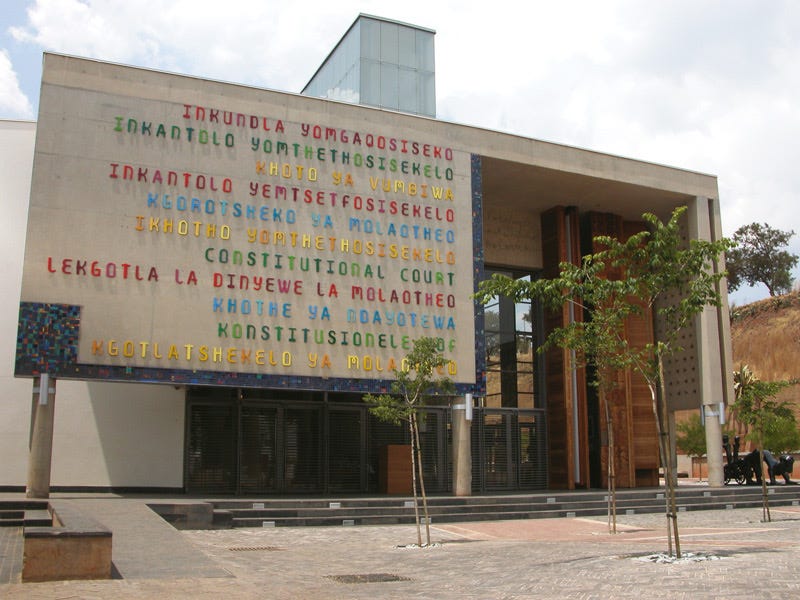
The judgment delivered this morning from Constitution Hill on the EFF and Another v Speaker of the National Assembly and Others (CCT 35/24) is, in constitutional sense, a reckoning with the limits of parliamentary majoritarianism, the meaning of executive accountability, and whether South Africa’s post-apartheid democratic state possesses genuine self-correcting mechanisms or merely the rhetoric form of them.
Parliament has been ordered to begin an impeachment inquiry against President Cyril Ramaphosa, after the Constitutional Court ruled that it acted irrationally by declining to adopt a report that found he may have violated his oath of office in connection with the burglary at his Phala Phala farm. That order, read by Chief Justice Mandisa Maya, lands with the weight of finality on this long running matter.
The road to this moment was an institutional drama. The judgment arrives exactly 521 days after the matter was argued before the Constitutional Court. That interval generated political pressure: the EFF conducted repeated demonstrations outside Constitution Hill, eventually prompting correspondence to the Chief Justice alleging that the delay bordered on judicial misconduct. Whatever one makes of that accusation, the pressure was real. The Chief Registrar confirmed, on behalf of the Chief Justice, that the judgment was at an advanced stage and would be handed down within a month — a rare and somewhat remarkable public communication that signalled the Court’s awareness of the reputational stakes involved.
The judgment’s central legal finding goes further than the outcome alone suggests. Chief Justice Maya found that Rule 129I effectively blocked an impeachment process without meaningful engagement on a motion during a parliamentary vote, and that this undermined the constitutional values of accountability and transparency. The rule was accordingly declared inconsistent with the Constitution and invalid. This is not a procedural quibble. It is a finding that Parliament’s own internal systems — the rules it designed to govern the Section 89 process — was constitutionally defective at its foundation.
The consequence of that finding flows with a certain juridical logic. Because the National Assembly’s vote against the report was taken under an invalid rule that prevented it from properly determining whether a ground for impeachment existed, the vote lacked a lawful foundation. The decision to reject the panel’s report was therefore declared irrational, unconstitutional, and set aside. This is a compound ruling of considerable force. It does not simply say Parliament reached the wrong conclusion, but that it reached the conclusion through a legally defective process — a process, moreover, that was never equipped to engage meaningfully with the evidence before it.
The distinction matters enormously. Had the Court found only that Parliament’s substantive conclusion was irrational, the plausible next argument would be about whether their individual members were bound to vote differently. But a finding that the procedural framework was constitutionally invalid removes that avenue. The defect was structural, not merely partisan.
The ANC’s conduct in December 2022 has been described as a “majoritarian shield” — the deployment of parliamentary numbers to insulate the President from an accountability process that the Constitution had expressly designed to remain independent of numerical manipulation. The apex court found that Parliament’s decision not to adopt the Section 89 panel report was irrational and invalid, and EFF leader Julius Malema read the ruling as confirming that the ANC had abused its parliamentary majority to protect President Ramaphosa. However one characterises Malema’s political statement, the juridical substance underneath it is now settled: the majoritarian vote of 13 December 2022 has been struck from the constitutional record as if it never validly occurred.
This has a doctrinal consequence that will outlast the Phala Phala matter itself. The Constitutional Court has now, across an increasingly coherent line of authority from the Nkandla decisions through the successive EFF judgments, established something close to an axiomatic principle: Parliament’s oversight function is not discretionary in the sense of being freely waivable. Where constitutionally mandated accountability mechanisms exist and are triggered by credible independent findings, Parliament’s obligation to engage with them in good faith is judicially enforceable. The implications here are far reaching in a sense that the use of a parliamentary majority as a protective cordon around the executive will, henceforth, be invalidated by our courts of law. That principle, now confirmed in the most politically charged accountability context in recent South African constitutional history, represents a significant development in the separation-of-powers jurisprudence of the democratic era in South Africa.
A secondary but significant strand of the judgment concerns mootness — the argument advanced by respondents that the dissolution of the 6th Parliament and the constitution of the 7th rendered the entire challenge academic. Chief Justice Maya addressed this directly, noting that an impeachment inquiry could take many months, and that the relief sought by the applicants was not moot, as the Court was not precluded from entertaining a challenge to the National Assembly’s rules. In rejecting the mootness submission, the Court necessarily affirmed the principle of parliamentary institutional continuity: the National Assembly of the 7th Parliament inherits the constitutional obligations that the 6th Parliament failed to discharge. A president cannot be insulated from accountability simply by running out the clock until dissolution.
The practical import of this principle will be felt in the coming weeks. The Chief Justice indicated that, until Rule 129I is amended, it is to be applied as follows: once the panel has reported, the Speaker must inform the National Assembly of the report — and the process that should properly have followed in December 2022 must now commence. Speaker Thoko Didiza is constitutionally obliged to place the Ngcobo Panel report before the Assembly and to initiate the establishment of an Impeachment Committee.
The impeachment inquiry that now opens, however, will operate in a materially different environment from the one that existed when the report was first tabled. The forensic record has grown considerably in the intervening years. The Independent Police Investigative Directorate released a long-suppressed report into the 2020 Phala Phala farm burglary, recommending disciplinary action against two members of the Presidential Protection Service — Major General Wally Rhoode and Constable HH Rekhoto — over alleged involvement in a cover-up. The Madlanga Commission’s proceedings have generated additional testimony. The criminal trial arising from the burglary continues. The Impeachment Committee will therefore not be working from allegations and inference alone; it will have access to a body of documentary and forensic material that renders the inquiry substantially more consequential than its 2022 precursor would have been.
The three zones of constitutional exposure identified in the Ngcobo Panel report — potential violations of Section 96(2)(a) relating to remunerative private business activity; potential violations of Section 96(2)(b) concerning abuse of office and conflicts of interest; and the failure to report obligations under Section 34(1) of PRECCA — remain live, and each will now be tested in a properly constituted forum with the power to subpoena witnesses, compel documentary production, and receive sworn testimony.
The political standing of the GNU now makes the Democratic Alliance the pivotal actor in what follows because the ANC no longer commands the parliamentary majority it possessed in December 2022, and the GNU’s internal makeup means that any significant parliamentary decision will require negotiation across party lines. DA leader Geordin Hill-Lewis stated that the judgment draws a clear line between the DA and the ANC, and that the DA’s position remains that accountability, constitutionalism, and the rule of law must always prevail. That is a strong formulation — strong enough to suggest that the DA intends to support the impeachment process proceeding. But supporting the establishment of an inquiry is a different political commitment from supporting a final removal vote. The DA may calculate, with some constitutional sophistication, that the integrity of the process is what it is obliged to defend, and that the outcome of the inquiry itself must be allowed to determine what follows.
The UDM, which holds a deputy ministerial role within the GNU, called on all political actors to approach the ruling with maturity, restraint, and respect for constitutional processes, and stated that it now awaited guidance from Speaker Thoko Didiza on the next steps. That cautious formulation from a GNU partner signals the strains the inquiry process will place on the coalition’s internal coherence. The process is constitutionally unavoidable; the political management of it is not.
The Presidency’s immediate response was measured. President Ramaphosa stated that he respects the Constitutional Court’s judgment and reaffirms his commitment to the Constitution, the independence of the judiciary, and the rule of law, and called on all South Africans to respect the judgment and all judicial institutions. What remains to be seen is whether the constitutional commitment it invokes will survive contact with the political pressures that the inquiry will generate.
What the Constitutional Court has done today is not to determine whether Cyril Ramaphosa is guilty of misconduct. It has determined that South Africa’s constitutional design requires that question to be properly asked — in a properly constituted forum, under a procedurally sound rule, with meaningful engagement rather than a majoritarian dismissal. The burden of that question now passes, as Chief Justice Maya’s order makes plain, to Parliament.
The defining constitutional question is no longer whether there is a case to answer. It is whether South Africa’s democratic institutions possess the political courage — and the institutional seriousness — to answer it.
Thank you for explaining this so clearly